Invisalign vs. Braces for Adults: Which Is Right for You?
A practical, no-hype comparison of Invisalign and traditional braces for adult patients. Cost, treatment time, results, and how to choose.
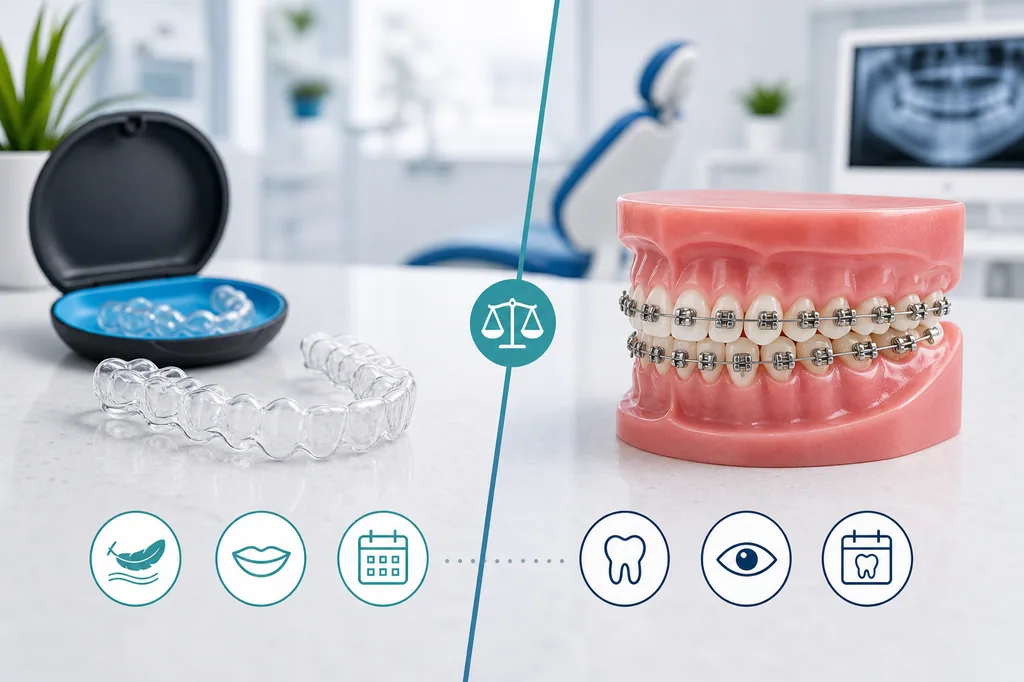
More adults than ever are straightening their teeth — and the choice between Invisalign and traditional braces is the first big decision. The honest answer to which is ‘better’ depends on your case and your priorities. Here’s a clear breakdown.
What Invisalign does well
Invisalign uses a series of clear, custom-made plastic aligners. You wear each set for 1–2 weeks before progressing to the next. The aligners are nearly invisible and you can remove them to eat, drink, brush, and floss.
For adults, the practical advantages are real: no metal in your professional headshots or wedding photos, easier oral hygiene than braces, fewer office visits, and the ability to take them out for a special meal or event.
What traditional braces still do better
Modern braces (metal or ceramic) bonded to your teeth can correct nearly any orthodontic problem — including severe bite issues, complex tooth rotations, and skeletal misalignments that Invisalign can’t fully address.
Braces also remove the compliance variable. They’re attached to your teeth, so they work whether you remember them or not. Invisalign only works if you actually wear the aligners 20–22 hours per day.
Cost comparison
In Northern Virginia, Invisalign for adults typically costs $4,000–$7,500. Traditional metal braces typically cost $3,500–$6,500. Ceramic braces are slightly more, $4,000–$7,000.
Many dental insurance plans cover both equally — typically a lifetime orthodontic benefit of $1,000–$3,000. We verify your specific benefits before treatment.
Treatment time
For comparable cases, treatment time is similar: most adult cases finish in 12–24 months. Simple cases (mild crowding, small gaps) can complete in 6–9 months with either Invisalign or braces.
Complex bite corrections sometimes finish faster with braces because they can apply more controlled force than aligners. We’ll give you an honest timeline estimate at your consultation.
How to decide
Choose Invisalign if: appearance during treatment matters to you, you have mild-to-moderate crowding or spacing, and you can commit to wearing aligners 22 hours per day.
Choose braces if: you have complex bite issues or severe rotations, you’d rather not think about compliance, or cost is a deciding factor.
At Hedgewood Dental, we evaluate every adult orthodontic case individually and tell you honestly which approach will produce the better result for your specific situation.
Frequently asked questions
Can Invisalign fix overbites and underbites?
Mild-to-moderate overbites and underbites can usually be corrected with Invisalign. Severe skeletal bite problems sometimes still require braces or, in rare cases, jaw surgery. A consultation with a 3D scan can determine which is appropriate.
Is Invisalign as effective as braces?
For most adult cases — crowding, spacing, mild bite issues — yes. For severe cases, traditional braces give the orthodontist more control. The right tool depends on the specific problem.
How long do I have to wear retainers after?
Regardless of which treatment you choose, you’ll wear retainers for life — full-time for the first few months, then nights only. Teeth naturally drift back without retainer support.
Both Invisalign and traditional braces produce excellent results when matched to the right case. The best path is an honest consultation with a dentist who’s experienced in both — not a sales pitch for one option. Call Hedgewood Dental to schedule an orthodontic consultation with Dr. Christine Mai.
Request an AppointmentRequest an Appointment
Share a few details—our team will follow up to confirm next steps.